


Contents
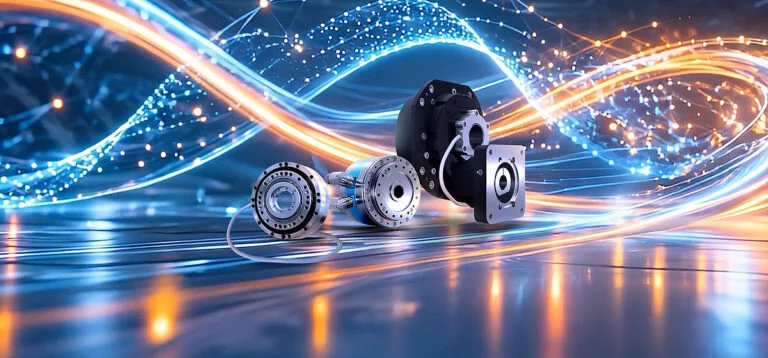
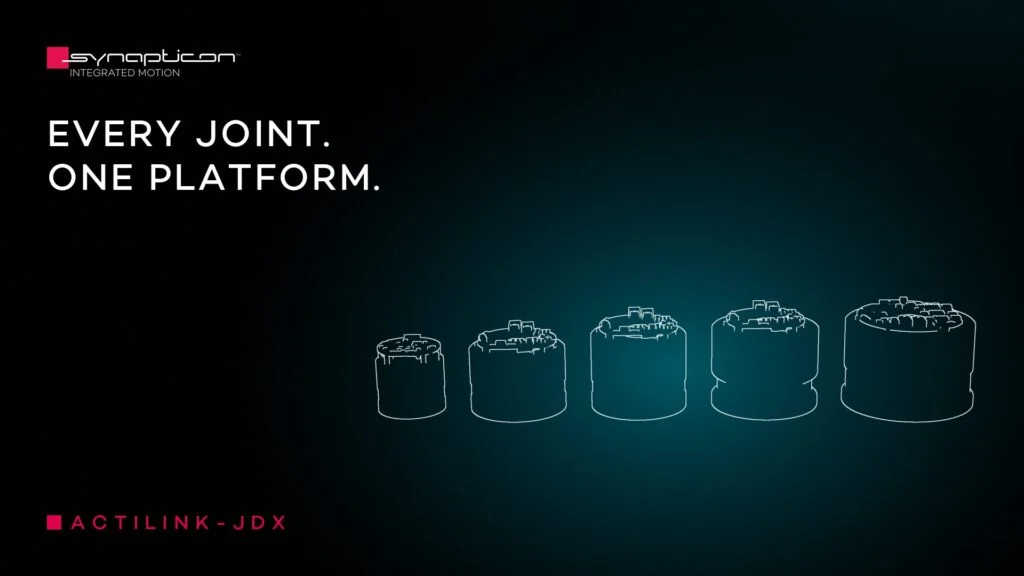
Synapticon has unveiled ACTILINK-JDX, a new platform of integrated actuators for humanoid and quadruped robots. Announced on 13 November 2026, the platform features what the company describes as its most powerful planetary gear actuators to date, with each unit combining a motor, gearbox, servo drive, encoder system and functional safety.
Two-stage planetary gearing inside the joint
At the heart of each ACTILINK-JDX unit is a two-stage planetary reduction coupled closely to a BLDC motor, with hollow-shaft versions offered across many of the models. Instead of occupying a separate housing, the servo electronics are built onto a round circuit board inside the motor itself, and the actuators communicate over EtherCAT. Synapticon has engineered the platform so that its functional safety can be certified, and it works with the company’s POSITRON SAFETY AI. The stated design targets are high power density and a low unit cost once volumes reach series production.
Why torque density and mass matter at every axis
According to Synapticon, a humanoid robot is equipped with about 30 actuators, each of which must deliver high torque within a very small installation space while weighing as little as possible, because every gram on one axis must be moved by the axes higher up in the kinematic chain. The company points to the leg as an example: every gram trimmed at the ankle is load that the knee and hip no longer have to carry. In Synapticon’s view, drives put together from separate components tend to be oversized for this job; its approach is instead to build the actuator around the manufacturer’s interface and the torque and speed the joint really needs, and to optimise weight and cost for the planned production volume.
“With a humanoid robot, the actuator determines whether the robot works and whether it can be mass-produced,” says Andrija Feher, CTO of Synapticon. He adds that the company develops the drive, electronics and safety systems as a single unit and aligns them with the robot’s overall system.
From a stock product line to series production
Customisation extends to the form factor, mechanical interface, motor winding, feature set and manufacturing process, each matched to the application and the expected volume. For manufacturers who want to start quickly, Synapticon will also offer a standard ACTILINK-JDX line held in stock. Where a standard unit falls short, it becomes the baseline for further optimisation, and the manufacturer does not have to change platforms on the way to series production.
Synapticon is now taking project inquiries for ACTILINK-JDX. Technical specifications are shared per project under a non-disclosure agreement, and manufacturers can ask for an NDA briefing through the product page.
Sources
- Synapticon GmbH, “Synapticon Announces New Actuators for Humanoid Robots”, press release, 13 November 2026 – synapticon.com
Image: Synapticon

Author